

If you’ve started learning Mandarin, you’ve probably realized one thing quickly: pronunciation is not just about sounds, it’s about tones. Unlike English, where pitch adds emotion, Mandarin uses pitch to create meaning. A single syllable can represent multiple words depending entirely on its tone.
Understanding the four tones plus the neutral tone is one of the most important steps in your Mandarin journey. Get this right early, and everything else becomes easier.
Why Tones Are So Important
Mandarin has many words that sound similar if you ignore tone. Tones act like a built-in system to separate meanings.
Take the syllable “ma”:

- mā (妈) – mother
- má (麻) – hemp
- mǎ (马) – horse
- mà (骂) – scold
- ma (吗) – question particle
Same spelling, completely different meanings. The only difference is tone.
The First Tone: High and Steady
The first tone is flat and high, like holding a musical note.
- Example: mā (妈) – mother
- Tone mark: ¯
When you say it, your voice should stay level without rising or falling.
Tip: Imagine you’re singing a steady note. No movement, just smooth and constant.
The Second Tone: Rising
The second tone rises from mid to high, similar to how your voice goes up when asking a question.
- Example: má (麻) – hemp
- Tone mark: ´
Tip: Say “what?” in surprise. That rising pitch is very close to the second tone.
The Third Tone: Falling then Rising

This tone dips down and then rises again.
- Example: mǎ (马) – horse
- Tone mark: ˇ
In natural speech, the full dip-and-rise is often shortened. Sometimes it stays low without rising.
Tip: Think of your voice as “scooping” down and then coming back up.
The Fourth Tone: Sharp and Falling
The fourth tone drops quickly and strongly.
- Example: mà (骂) – scold
- Tone mark: `
It often sounds firm or even a bit aggressive.
Tip: Imagine giving a command like “Stop!” That sharp drop is the fourth tone.
The Neutral Tone: Light and Quick
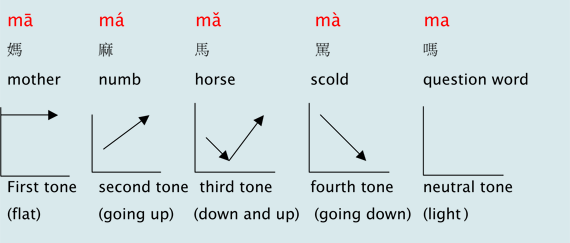
The neutral tone is different from the other four. It is unstressed, short, and soft.
- Example: ma (吗) – question particle
- Tone mark: none
It doesn’t have a fixed pitch. Instead, its sound depends on the tone before it.
Tip: Say it quickly and lightly, almost like it “fades away.”
Common Challenges Learners Face
Many beginners struggle with tones, and that’s completely normal. The most common issues include:
- Mixing up the second and third tones
- Not making the fourth tone strong enough
- Ignoring tones entirely (this leads to misunderstandings)
- Over-pronouncing the neutral tone
The key is consistent listening and speaking practice.
How to Practice Tones Effectively
To really improve, you need active practice:
- Listen and imitate native speakers
- Practice minimal pairs (like mā vs mǎ)
- Exaggerate tones at first, then refine them
- Record yourself and compare
- Practice daily, even just 10–15 minutes
Tones are not optional in Mandarin. They are part of every word. Think of them as the “soul” of pronunciation. Without them, communication becomes unclear or even incorrect.
The good news is that with regular practice, your ears will adjust, and tones will start to feel natural.
Master the tones early, and you’ll build a strong foundation for everything else in Mandarin.